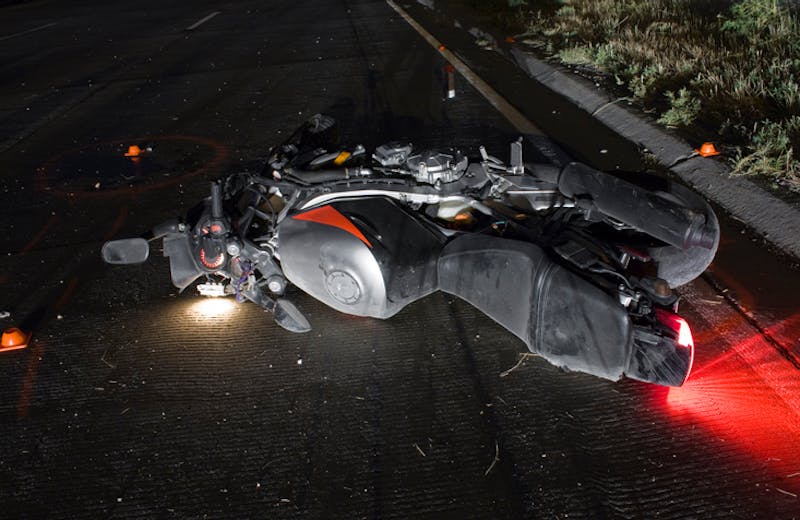
Proving fault in a Connecticut motorcycle accident case comes down to showing that another party was negligent and that this negligence caused the crash and the resulting injuries. That means gathering evidence of the four legal elements of negligence, understanding how Connecticut's comparative fault rule can reduce or eliminate a claim, and knowing how helmet use factors into an injury case under state law.
At Goff Law Group, founding attorney Brooke Goff has built a reputation across Connecticut for aggressive, detail-driven representation of injured motorcyclists, earning Super Lawyers Rising Stars recognition for eight consecutive years while helping clients recover millions of dollars in settlements and verdicts.
This guide breaks down exactly what goes into proving fault after a motorcycle crash, from the legal definitions involved to the practical steps riders should take at the scene.
What Is Negligence in a Motorcycle Accident Claim?
Negligence is the legal failure to exercise the level of care a reasonably prudent person would use under similar circumstances. In a motorcycle accident case, this typically means proving that a driver, a government entity responsible for road maintenance, or another party acted carelessly and caused the crash.
To succeed on a negligence claim, a plaintiff generally must establish four separate elements. Each one must be supported by evidence, and missing even one can defeat a claim entirely:
| Element | Plain-Language Definition |
| Duty of Care | The at-fault party owed a legal obligation to act reasonably (e.g., every driver owes other road users a duty to obey traffic laws). |
| Breach of Duty | The at-fault party failed to meet that obligation, such as by speeding, running a red light, or turning without checking for motorcycles. |
| Causation | The breach directly caused the crash and the resulting injuries, not some unrelated factor. |
| Damages | The rider suffered actual, quantifiable harm, such as medical bills, lost wages, or pain and suffering. |
Comparative Fault in Connecticut
Comparative fault determines how much compensation an injured rider can recover when more than one party contributed to a crash. Under Connecticut General Statutes § 52-572h, a plaintiff can still recover damages as long as their own share of fault does not exceed 50 percent. If a rider is found 51 percent or more at fault, state law bars any recovery entirely.
| Rider's Assigned Fault | Total Damages | Amount Recoverable |
| 0% | $200,000 | $200,000 |
| 20% | $200,000 | $160,000 |
| 49% | $200,000 | $102,000 |
| 51% | $200,000 | $0 (barred from recovery) |
How Connecticut Motorcycle Helmet Laws Affect Your Injury Claim
Connecticut has a partial helmet law. Under Connecticut General Statutes § 14-289g, the helmet requirement breaks down as follows:
- Operators and passengers under 18 years old must wear an approved protective helmet at all times while riding
- Anyone riding on a learner's permit, regardless of age, must wear an approved helmet while operating the motorcycle
- Adult riders 18 and older, outside of the learner's permit situation above, are not required by state law to wear a helmet
Because the helmet requirement applies only to minors and permit holders, an adult rider's decision not to wear a helmet generally cannot, by itself, be used to establish that the rider violated a legal duty of care.
Insurance companies sometimes still argue that going without a helmet increased the severity of injuries, so riders involved in a crash while unhelmeted should expect this issue to come up during negotiations, even though it carries less legal weight than in states with universal helmet laws.
For riders under 18, failing to wear a helmet as required by § 14-289g can be used as evidence of comparative negligence, potentially reducing an available recovery. This makes it important for parents and guardians of injured teen riders to address the helmet question directly with their attorney rather than assume it will not come up.
Helmet use also affects the medical side of a claim, regardless of legal fault. According to the National Highway Traffic Safety Administration, helmets are estimated to be roughly 37 percent effective at preventing rider fatalities and about 41 percent effective for passengers.
In practice, this means:
- Helmet use can meaningfully affect the severity of injuries documented in medical records, even when it does not change the liability analysis
- Treating physicians and hospital records may reference helmet use when describing the mechanism of a head or neck injury, which can become part of the medical evidence in a claim
- Photos of a damaged or undamaged helmet from the scene can help corroborate the medical record's description of impact forces
Who Can Be Held Liable in a Motorcycle Accident
Fault does not always rest with a single driver. Depending on the facts, liability in a motorcycle accident case may extend to:
- Other drivers who violated traffic laws, drove distracted, or failed to check for motorcycles before turning or changing lanes
- Vehicle or parts manufacturers, if a defective motorcycle component contributed to the crash
- Government entities, when poor road maintenance, missing signage, or a dangerous road design was a contributing factor
- Employers, when a commercial driver caused the crash while acting within the scope of their job
Identifying every liable party matters because it can affect how damages are apportioned under Connecticut's comparative fault framework and how much total compensation is ultimately available.
Types of Evidence That Prove Fault
Strong motorcycle accident claims are built on layered, corroborating evidence rather than a single piece of proof. The following sources are commonly used to establish fault:
- Police accident reports, which document the officer's on-scene observations, citations issued, and preliminary fault assessment
- Witness statements from bystanders, passengers, or other drivers who saw the crash unfold
- Photos and video of the vehicles, road conditions, skid marks, and the surrounding scene, including any available traffic or surveillance camera footage
- Event data recorder (black box) information from an at-fault vehicle, which can show speed, braking, and steering inputs before impact
- Cell phone and telematics records, which can reveal whether a driver was texting or on a call at the time of the crash
- Accident reconstruction analysis from a qualified expert, particularly in cases involving disputed speed, angle of impact, or sightline obstructions
Steps to Take After a Motorcycle Accident to Preserve Evidence
What happens in the hours and days after a crash often determines how strong a fault claim will be. Riders and their families should take the following steps whenever it is safe to do so:
- Seek medical attention immediately, even if injuries seem minor. Adrenaline can mask symptoms, and a documented medical evaluation creates a timestamped record connecting the crash to any injuries.
- Call the police to the scene so that an official accident report can be generated. This report often serves as foundational evidence for the claim.
- Photograph the scene before vehicles are moved, including damage to the motorcycle, road conditions, traffic signals, and any visible injuries.
- Preserve damaged gear, such as a helmet, riding jacket, or gloves, since this equipment can later help demonstrate the force of impact.
- Get contact information from witnesses before they leave the scene, since locating them later can be difficult.
- Avoid recorded statements to insurance adjusters until speaking with an attorney, as early statements are sometimes used to argue comparative fault later.
- Contact a motorcycle accident lawyer promptly so that evidence, such as surveillance footage and event data recorder information, can be requested before it is deleted or overwritten.
Why Connecticut Riders Trust Goff Law Group
Motorcycle accident cases raise issues that do not come up in typical car accident claims, from disputes over lane positioning to insurer bias against riders. The attorneys at Goff Law Group bring firsthand familiarity with these issues to every case, including team members who ride motorcycles themselves and understand the unique risks riders face on Connecticut roads.
Every motorcycle case is handled with the same rigor: identifying every liable party, preserving time-sensitive evidence, and pushing back when an insurer tries to inflate a rider's share of fault.
Goff Law Group has built a 99% success rate for clients and earned more than 491 five-star reviews by handling exactly this kind of case with the attention it demands.
If you were injured in a motorcycle accident, contact Goff Law Group for a free case evaluation to discuss what evidence may support your claim.
Disclaimer: The information in this article is provided for general educational purposes only and does not constitute legal advice. Motorcycle accident law is highly fact-specific, and every case is different. Nothing here should be relied on as a substitute for speaking with a qualified attorney about your particular situation.
Sources
- Connecticut General Statutes § 52-572h, Negligence Actions: cga.ct.gov
- Connecticut General Assembly, Office of Legislative Research Report 2006-R-0172, on apportionment under § 52-572h: cga.ct.gov
- Connecticut General Assembly, Office of Legislative Research Report 2010-R-0465, on motorcycle helmet requirements under § 14-289g: cga.ct.gov
- National Highway Traffic Safety Administration, Traffic Safety Facts: Motorcycles (2021 Data): crashstats.nhtsa.dot.gov
- National Highway Traffic Safety Administration, Traffic Safety Facts: Motorcycles (2008 Data), helmet effectiveness estimates: crashstats.nhtsa.dot.gov
- Connecticut Crash Data Repository, University of Connecticut Transportation Safety Research Center and CTDOT: ctcrash.uconn.edu